

Florida inventory tells a split-market story
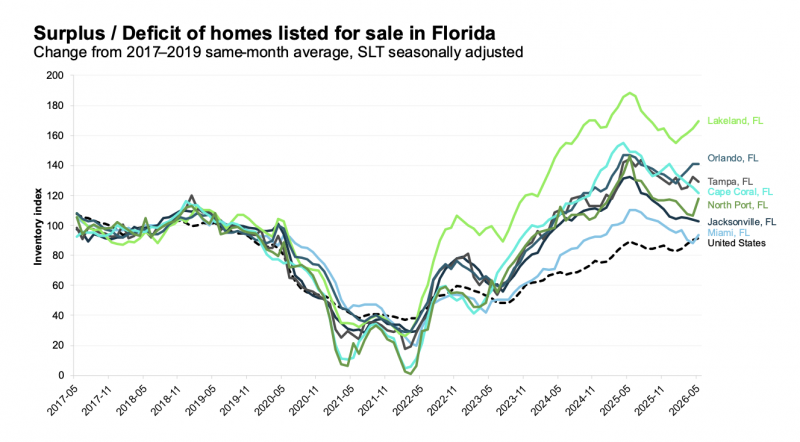
The July 2026 Mortgage Monitor found most major Florida metros have more inventory than before the pandemic, though levels have eased from last year’s highs. Lakeland and Orlando had the largest surpluses, while Miami was the only major Florida market tracked below pre-pandemic norms.
Florida’s housing market is carrying more inventory than it did before the pandemic in most major metros, but the story is not the same everywhere, according to the July 2026 Mortgage Monitor from ICE (Intercontinental Exchange) Mortgage Technology.
The company noted every major Florida market it tracked except Miami was above pre-pandemic inventory norms in May. At the same time, those markets have eased from last year’s highs, which the report said is “softening downward pressure on prices.”
Lakeland and Orlando stood out in the ICE Monitor report because both had far more homes on the market than they typically did before the pandemic. Lakeland’s listed inventory was 69% higher than its normal May level from 2017 to 2019, while Orlando was 41% higher. ICE said inventory in both markets has also started moving up again in recent months.
The report’s broader point is that supply and prices are moving together. ICE found a clear pattern: Markets with extra inventory are seeing weaker price growth, while markets with fewer homes for sale are still posting stronger gains. More listings give buyers more choices and reduce upward pressure on prices.
That makes local context especially important. A buyer in Lakeland or Orlando may be looking at a very different set of choices than a buyer in Miami. Sellers may also need a more precise read on their competition, especially in markets where inventory has moved back up.
ICE’s Florida chart included Miami, Jacksonville, Tampa, Lakeland, Orlando, Cape Coral and North Port (see below). The takeaway is simple: Statewide trends can be useful, but they do not replace a close look at what is happening market by market
 |
|
Source: ICE Mortgage Technology |
© 2026 Florida Realtors®